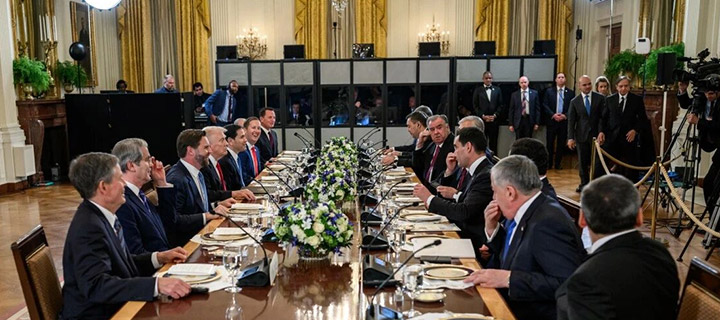
Amidst the rare earth competition, Central Asia has become a focal point of the "21st-century great game" between the US, China, and Russia. On November 6th, Trump hosted the leaders of five Central Asian countries at the White House, with the core objective being the acquisition of rare earth and other key minerals. China controls approximately 90% of the world's rare earth processing capacity. After expanding export restrictions in October 2024, the US is eager to find alternative supply sources, making resource-rich Central Asia a key target, especially given the potential to leverage the "Middle Corridor" to secure transportation routes.
Rare earths are core materials for high-tech industries and defense equipment. The International Energy Agency predicts that global demand for critical minerals will triple by 2040. Central Asia accounts for about half of the world's uranium production. Kazakhstan possesses the world's third-largest rare earth reserves and the largest undeveloped tungsten deposit. Uzbekistan has discovered deposits containing more than 30 rare metals and plans to invest $2.6 billion in 76 projects. Tajikistan has also discovered strategic metal deposits, making it a focal point of competition among major powers.
Currently, the Central Asian mining sector presents a multi-power rivalry: China holds most rare earth mining leases in Kyrgyzstan and Tajikistan and monopolizes core processing technologies; Russia dominates Kazakhstan's uranium industry and is a major importer of key minerals; the United States has recently taken frequent actions, facilitating the development of tungsten mines in Kazakhstan, and the US and Kazakhstan have also signed a $4.2 billion railway agreement to support the "Middle Corridor" project.
In this "great game of the 21st century," each country has a clear objective: the United States seeks to reduce its dependence on Chinese rare earths through investment and infrastructure cooperation, thus counterbalancing the influence of China and Russia in Central Asia; China, leveraging its geographical advantages and technological barriers, consolidates its dominant position, using rare earths as a geopolitical tool; Russia, on the other hand, maintains its regional influence through uranium industry cooperation, viewing China as a counterbalancing force against Western powers; and Central Asian countries hope to obtain investment and develop their own resources through a balance of power among major nations.
Looking ahead, the United States needs to overcome multiple constraints, including political, infrastructure, and environmental ones, to make Central Asia a reliable supplier. If Central Asian countries cannot break free from their existing supply chain dependence, they will likely remain reliant on China and Russia. This struggle over rare earth elements is not only about restructuring the global supply chain, but also about reshaping the geopolitical landscape.
Forwarded from Yuzi Important Matters