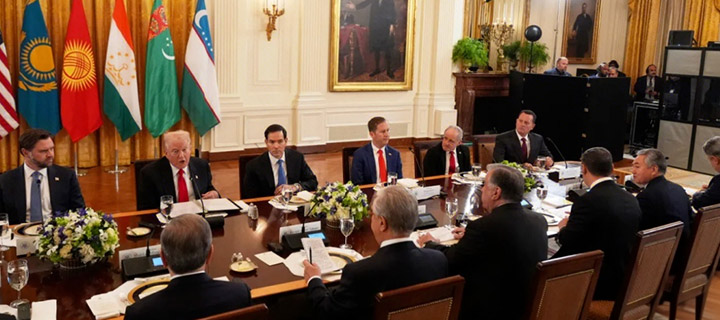
November 6, 2025,The annual "C5+1" summit between the United States and the five Central Asian countries was held in Washington. The Trump administration prioritized key minerals in its foreign policy, emphasizing the importance of Central Asian resources and aiming to broaden the supply chain of key minerals through deepening partnerships to safeguard U.S. economic security. This summit focused on three main areas: the business environment, trade and investment and key minerals, and connectivity across the Caspian Corridor. It did not address climate change or security cooperation, a departure from the comprehensive cooperation approach of the Biden administration.
The "C5+1" mechanism began in 2015 and was upgraded to a head-of-state level cooperation in 2023. Since Trump took office, U.S.-Central Asia trade agreements have exceeded $10 billion, shifting the focus of cooperation to trade and economics. Kazakhstan, a major mineral-producing country in Central Asia, boasts world-leading reserves of rare earth, tungsten, and uranium. Recently, a giant rare earth deposit was discovered, and the U.S. and Kazakhstan signed a $17 billion commercial agreement covering cooperation on 19 strategic minerals. U.S. companies acquired two large tungsten mines, and cooperation is also involved in aviation, AI, and infrastructure. Kazakhstan also announced its accession to the Abraham Accords, receiving support from the United States and Jewish groups, and pushed its parliament to repeal the Jackson-Vanick Amendment to lift trade restrictions.
Uzbekistan, possessing abundant rare metal resources, plans to invest $2.6 billion over three years in 76 mining projects. The US and Uzbekistan reached a major trade agreement, with Uzbekistan investing nearly $35 billion in the US over the next three years and exceeding $100 billion over ten years, covering key minerals, aviation, and other sectors. Uzbekistan also proposed establishing a dedicated agency to coordinate cooperation. Trump stated that the US is working with multiple countries to build a key mineral supply system, striving to reduce dependence on China within 18 months.
Analysts believe that the US aims to make Central Asia a key node in the "de-Sinicization" of its mineral supply chain, but Central Asia has close geo-economic ties with China and Russia. For Central Asian countries, balancing relations with the US, China, and Russia while maximizing benefits through cooperation has become a crucial issue.
Forwarded from Jingdao New Media