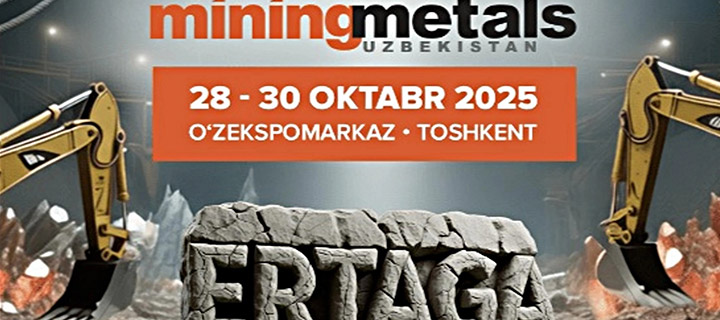
Central Asia is emerging as a strategic player in global critical mineral security, with deepening green cooperation between China and Uzbekistan. With abundant reserves of critical minerals such as gold, uranium, and antimony, Central Asia is rising as a key force in the global mineral market. Kazakhstan accounts for 43% of global uranium production, Uzbekistan ranks tenth globally in gold production, and Kyrgyzstan and Tajikistan are also developing antimony and tungsten deposits. The 2025 Central Asia Mining and Metallurgy Exhibition Forum, held in Tashkent, focused on the theme "Central Asia: An Emerging Strategic Player in Global Critical Mineral Security," attracting global industry attention.
Uzbekistan is accelerating its integration into the global industrial chain, promoting mining development through multiple measures: increasing investment in geological exploration and scientific research over the next three years to enhance rare metal extraction and high-value-added production capabilities; preparing 18 industrial waste recycling projects; planning to build science and technology parks in Samarkand and Tashkent; launching 76 rare metal projects worth $2.6 billion; and attracting over 60 domestic and foreign investors to its technical metal complex; implementing a new Law on Underground Resources and related amendments in 2025 to optimize licensing and supervision, and introducing foreign investment incentives such as tax breaks; adhering to green and sustainable development, promoting water and energy conservation and post-mine remediation, obtaining ESG certification, and introducing internationally advanced technologies. These efforts have yielded significant results: in 2024, the Navoi Mining and Metallurgical Complex saw a 5.4% year-on-year increase in gold production; and in the first five months of 2025, gold exports reached $6.49 billion, a 54.8% year-on-year increase.
The international community has responded positively to Uzbekistan's initiatives. Kazakhstan plans to deepen cooperation with Uzbekistan on key minerals, and the EU supports Uzbekistan in building a vertical value chain for its mining industry. Cooperation between China and Uzbekistan is particularly prominent, with green development at its core. A "Green Minerals" working group has been established, focusing on cooperation in areas such as renewable energy and technologically advanced metals. The Uzbekistan Technological Metals Consortium has established cooperative relationships with Chinese enterprises, and the two sides have also carried out joint talent training programs, implementing a "1+1" joint master's program and a training program for technical personnel to study in China, achieving complementary advantages in resources, technology, capital, and talent.
China-Uzbekistan mineral cooperation covers multiple dimensions, serving the interests of both countries and providing support for global mineral security, sustainable energy development, and industrial technology innovation.
Forwarded from Northwest Central Asia International Business