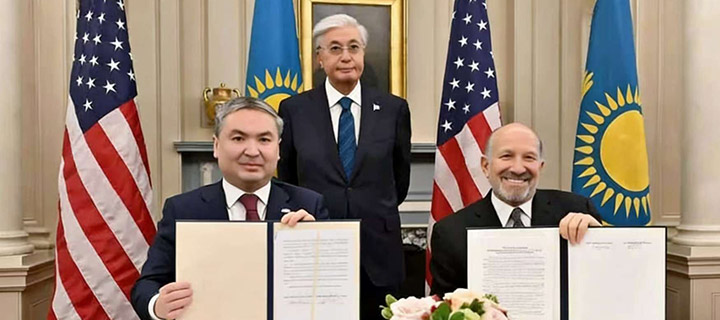
he US-Kazakhstan tungsten mining cooperation is reshaping the global landscape of key minerals. In November 2025, during the "C5+1" summit in Washington, D.C., Cove Capital of the United States and Kazakhstan's Tau-Ken-Samruk signed an agreement to jointly develop the world's largest undeveloped tungsten deposit in the Karaganda region. The US will hold a 70% stake, and the project boasts 1.4 million tons of tungsten trioxide resources, accounting for 70% of Kazakhstan's total reserves. This move is seen as a key step in the US strategy to break China's monopoly on the tungsten supply chain—China controls more than 80% of global tungsten production capacity, and will impose export controls on the US starting in 2025, prompting the US to accelerate the construction of alternative supply chains.
Kazakhstan's strategic importance in key minerals is becoming increasingly apparent. Tungsten, due to its high-temperature resistance and high strength, is a core material for defense and high-end manufacturing. Kazakhstan also possesses lithium reserves of 226,800 tons (MDPI data), and its uranium production is among the world's leading. To achieve industrial upgrading, Kazakhstan will implement a ban on the export of non-ferrous metal ore in 2025, promote the increase of the processing and manufacturing sector to 14%, and empower the modernization of the mining industry through digital transformation and Industry 4.0 technologies. Concurrently, the Consultative Meeting of Heads of State of Central Asia admitted Azerbaijan as a full member, focusing on regional cooperation such as rare earth development, and creating a favorable environment for mineral trade.

Facing the restructuring of the global supply chain, Chinese enterprises are presented with multiple opportunities: they can leverage their leading rare earth refining and tungsten processing technologies to participate in high-value-added projects in Kazakhstan; they can enter the US-Kazakhstan cooperation industrial chain as suppliers of mining machinery and environmental protection equipment, achieving a win-win situation of risk mitigation and complementary support; and they can learn from Zijin Mining's successful experience of acquiring the Raygorodok gold mine for $1.2 billion to deepen cooperation on large-scale projects. At the same time, Chinese enterprises need to pay attention to Kazakhstan's localization policies, meet local employment ratio requirements, cooperate with occupational safety upgrades and compliance reviews, and position themselves as enablers of Kazakhstan's industrial upgrading.
US-Kazakhstan cooperation marks a new stage in the competition for key mineral resources, and Kazakhstan's strategic choices profoundly impact the global supply chain landscape. Only by leveraging their technological and production capacity advantages and deepening localization cooperation through a mutually beneficial model can Chinese enterprises carve out new space in the great power competition and regional industrial transformation.
Forwarded from VietLook